Review


recombinant mouse il 17a f protein  (R&D Systems)


Bioz Verified Symbol R&D Systems is a verified supplier
Bioz Manufacturer Symbol R&D Systems manufactures this product  
  • Logo
  • About
  • News
  • Press Release
  • Team
  • Advisors
  • Partners
  • Contact
  • Bioz Stars
  • Bioz vStars
  • 94

    Structured Review

    R&D Systems recombinant mouse il 17a f protein
    <t>IL‐17A</t> and IL‐17F gene and protein expression in lungs of BLM challenged mice. WT mice were treated with saline (CL, white bars) or BLM (grey bars) for 6 h, 24 h, 72 h, 7 days, 14 days, or 21 days, as indicated. (A, B) Gene expression levels of IL‐17A and IL‐17F in sorted TCRαβ pos (A) and TCRγδ pos T cells collected from lungs of BLM‐exposed WT mice. (C, D) Intracellular IL‐17A and IL‐17F protein expression of CD4 pos T cells (C) and TCRγδ pos T cells (D) of WT and IL17af −/− mice was measured 72 h post‐BLM by flow cytometry. (E, F) IL‐17A protein levels in BALF (E) and lung (F) of saline vs. BLM‐treated mice quantified by ELISA. Data are shown as scatter plots with mean values indicated as horizontal lines (A, B) or as mean ± SD of n = 9–12 (A, B), or n = 5–11 (C, D), or n = 4–8 (E, F) mice per group and time point. Note that in A and B, one data point represents a pool of T cells sorted from n = 2–3 mice per experimental group and time point. Data in (C–F) are representative of two independent experiments. * p ≤ 0.05, ** p ≤ 0.01 compared with mice from the control group (Mann–Whitney U ‐test).
    Recombinant Mouse Il 17a F Protein, supplied by R&D Systems, used in various techniques. Bioz Stars score: 94/100, based on 162 PubMed citations. ZERO BIAS - scores, article reviews, protocol conditions and more
    https://www.bioz.com/result/recombinant mouse il 17a f protein/product/R&D Systems
    Average 94 stars, based on 162 article reviews
    recombinant mouse il 17a f protein - by Bioz Stars, 2026-02
    94/100 stars

    Images

    1) Product Images from "Innate T‐cell‐derived IL‐17A/F protects from bleomycin‐induced acute lung injury but not bleomycin or adenoviral TGF‐β1‐induced lung fibrosis in mice"

    Article Title: Innate T‐cell‐derived IL‐17A/F protects from bleomycin‐induced acute lung injury but not bleomycin or adenoviral TGF‐β1‐induced lung fibrosis in mice

    Journal: European Journal of Immunology

    doi: 10.1002/eji.202451323

    IL‐17A and IL‐17F gene and protein expression in lungs of BLM challenged mice. WT mice were treated with saline (CL, white bars) or BLM (grey bars) for 6 h, 24 h, 72 h, 7 days, 14 days, or 21 days, as indicated. (A, B) Gene expression levels of IL‐17A and IL‐17F in sorted TCRαβ pos (A) and TCRγδ pos T cells collected from lungs of BLM‐exposed WT mice. (C, D) Intracellular IL‐17A and IL‐17F protein expression of CD4 pos T cells (C) and TCRγδ pos T cells (D) of WT and IL17af −/− mice was measured 72 h post‐BLM by flow cytometry. (E, F) IL‐17A protein levels in BALF (E) and lung (F) of saline vs. BLM‐treated mice quantified by ELISA. Data are shown as scatter plots with mean values indicated as horizontal lines (A, B) or as mean ± SD of n = 9–12 (A, B), or n = 5–11 (C, D), or n = 4–8 (E, F) mice per group and time point. Note that in A and B, one data point represents a pool of T cells sorted from n = 2–3 mice per experimental group and time point. Data in (C–F) are representative of two independent experiments. * p ≤ 0.05, ** p ≤ 0.01 compared with mice from the control group (Mann–Whitney U ‐test).
    Figure Legend Snippet: IL‐17A and IL‐17F gene and protein expression in lungs of BLM challenged mice. WT mice were treated with saline (CL, white bars) or BLM (grey bars) for 6 h, 24 h, 72 h, 7 days, 14 days, or 21 days, as indicated. (A, B) Gene expression levels of IL‐17A and IL‐17F in sorted TCRαβ pos (A) and TCRγδ pos T cells collected from lungs of BLM‐exposed WT mice. (C, D) Intracellular IL‐17A and IL‐17F protein expression of CD4 pos T cells (C) and TCRγδ pos T cells (D) of WT and IL17af −/− mice was measured 72 h post‐BLM by flow cytometry. (E, F) IL‐17A protein levels in BALF (E) and lung (F) of saline vs. BLM‐treated mice quantified by ELISA. Data are shown as scatter plots with mean values indicated as horizontal lines (A, B) or as mean ± SD of n = 9–12 (A, B), or n = 5–11 (C, D), or n = 4–8 (E, F) mice per group and time point. Note that in A and B, one data point represents a pool of T cells sorted from n = 2–3 mice per experimental group and time point. Data in (C–F) are representative of two independent experiments. * p ≤ 0.05, ** p ≤ 0.01 compared with mice from the control group (Mann–Whitney U ‐test).

    Techniques Used: Expressing, Saline, Flow Cytometry, Enzyme-linked Immunosorbent Assay, Control, MANN-WHITNEY

    Therapy of BLM‐treated IL17af −/− mice with recombinant IL‐17A/F protein. (A) Experimental design. BLM‐exposed IL17af −/− mice were treated i.v. with rIL‐17A/F protein or vehicle, as indicated. (B) Histopathology of hematoxylin/eosin‐stained lung tissue section of IL17af −/− mice with or without rIL‐17A/F protein therapy at day 6 post‐BLM treatment. Closed arrows in (B, left histology) indicate angiocentric neutrophilic infiltrations, while open arrows in (B, left histology) denote intravascular coagulation in IL17af −/− mice treated with BLM for 6 days. Closed arrows in (B, right histology) indicate lymphoplasmacellular infiltrates in BLM‐treated IL17af −/− mice with rIL‐17A/F protein therapy. Representative histology images from a total of n = 4 mice per experimental group are shown at original magnifications of ×40 (Scale bar 20 µm). (C–E) Immunophenotypic analysis of neutrophils (C), CD4 pos T cells (D), and CD8 pos T cells (E) in BALF of BLM‐treated IL17af −/− mice in the absence or presence of rIL‐17A/F protein therapy. Data are shown as mean±SD of n = 5–6 mice per group and time point and are representative of two independent experiments. * p ≤ 0.05, ** p ≤ 0.01 compared with mice from the control group (CL). ++ p ≤ 0.01 rIL‐17A/F application relative to vehicle (Mann–Whitney U ‐test).
    Figure Legend Snippet: Therapy of BLM‐treated IL17af −/− mice with recombinant IL‐17A/F protein. (A) Experimental design. BLM‐exposed IL17af −/− mice were treated i.v. with rIL‐17A/F protein or vehicle, as indicated. (B) Histopathology of hematoxylin/eosin‐stained lung tissue section of IL17af −/− mice with or without rIL‐17A/F protein therapy at day 6 post‐BLM treatment. Closed arrows in (B, left histology) indicate angiocentric neutrophilic infiltrations, while open arrows in (B, left histology) denote intravascular coagulation in IL17af −/− mice treated with BLM for 6 days. Closed arrows in (B, right histology) indicate lymphoplasmacellular infiltrates in BLM‐treated IL17af −/− mice with rIL‐17A/F protein therapy. Representative histology images from a total of n = 4 mice per experimental group are shown at original magnifications of ×40 (Scale bar 20 µm). (C–E) Immunophenotypic analysis of neutrophils (C), CD4 pos T cells (D), and CD8 pos T cells (E) in BALF of BLM‐treated IL17af −/− mice in the absence or presence of rIL‐17A/F protein therapy. Data are shown as mean±SD of n = 5–6 mice per group and time point and are representative of two independent experiments. * p ≤ 0.05, ** p ≤ 0.01 compared with mice from the control group (CL). ++ p ≤ 0.01 rIL‐17A/F application relative to vehicle (Mann–Whitney U ‐test).

    Techniques Used: Recombinant, Histopathology, Staining, Coagulation, Control, MANN-WHITNEY

    AdTGF‐β1 induced lung fibrosis in WT and IL17af −/− mice. WT and IL17af −/− mice were left untreated (grey bars) or were treated with either AdCL (white bars) or AdTGF‐β1 (black bars) for up to 21 days. (A, B) IL‐17A protein levels in BALF (A) and lung (B) of AdCL vs. AdTGF‐β1‐treated mice. (C) Hydroxyproline levels in lung tissue of AdCL‐ vs. AdTGF‐β1‐treated WT and IL17af −/− mice. (D) Histopathology of hematoxylin/eosin‐stained lung tissue sections of WT and IL17af −/− mice at day 14 post‐AdCL vs. AdTGF‐β1 application. Data are shown as mean ± SD of at least n = 5–8 mice per experimental group and time point and are representative of two independent experiments. * p ≤ 0.05, ** p ≤ 0.01 compared with AdCL.
    Figure Legend Snippet: AdTGF‐β1 induced lung fibrosis in WT and IL17af −/− mice. WT and IL17af −/− mice were left untreated (grey bars) or were treated with either AdCL (white bars) or AdTGF‐β1 (black bars) for up to 21 days. (A, B) IL‐17A protein levels in BALF (A) and lung (B) of AdCL vs. AdTGF‐β1‐treated mice. (C) Hydroxyproline levels in lung tissue of AdCL‐ vs. AdTGF‐β1‐treated WT and IL17af −/− mice. (D) Histopathology of hematoxylin/eosin‐stained lung tissue sections of WT and IL17af −/− mice at day 14 post‐AdCL vs. AdTGF‐β1 application. Data are shown as mean ± SD of at least n = 5–8 mice per experimental group and time point and are representative of two independent experiments. * p ≤ 0.05, ** p ≤ 0.01 compared with AdCL.

    Techniques Used: Histopathology, Staining


    Similar Products

    94
    R&D Systems recombinant mouse il 17a f protein
    <t>IL‐17A</t> and IL‐17F gene and protein expression in lungs of BLM challenged mice. WT mice were treated with saline (CL, white bars) or BLM (grey bars) for 6 h, 24 h, 72 h, 7 days, 14 days, or 21 days, as indicated. (A, B) Gene expression levels of IL‐17A and IL‐17F in sorted TCRαβ pos (A) and TCRγδ pos T cells collected from lungs of BLM‐exposed WT mice. (C, D) Intracellular IL‐17A and IL‐17F protein expression of CD4 pos T cells (C) and TCRγδ pos T cells (D) of WT and IL17af −/− mice was measured 72 h post‐BLM by flow cytometry. (E, F) IL‐17A protein levels in BALF (E) and lung (F) of saline vs. BLM‐treated mice quantified by ELISA. Data are shown as scatter plots with mean values indicated as horizontal lines (A, B) or as mean ± SD of n = 9–12 (A, B), or n = 5–11 (C, D), or n = 4–8 (E, F) mice per group and time point. Note that in A and B, one data point represents a pool of T cells sorted from n = 2–3 mice per experimental group and time point. Data in (C–F) are representative of two independent experiments. * p ≤ 0.05, ** p ≤ 0.01 compared with mice from the control group (Mann–Whitney U ‐test).
    Recombinant Mouse Il 17a F Protein, supplied by R&D Systems, used in various techniques. Bioz Stars score: 94/100, based on 1 PubMed citations. ZERO BIAS - scores, article reviews, protocol conditions and more
    https://www.bioz.com/result/recombinant mouse il 17a f protein/product/R&D Systems
    Average 94 stars, based on 1 article reviews
    recombinant mouse il 17a f protein - by Bioz Stars, 2026-02
    94/100 stars
      Buy from Supplier

    94
    R&D Systems recombinant mouse il 17a
    A,B. Colonoids were prepared from control mice ( Duoxa1/a2 fl/fl ) or those lacking functional intestinal DUOX2 ( Duoxa1/a2 ΔIEC mice) to evaluate H 2 O 2 production and gene expression in response to recombinant murine IL-17 (rmIL-17). Colonoids were stimulated for 24 h with 5 ng/mL of <t>rmIL-17A</t> or the equivalent amount of carrier BSA protein (n=6 cultures). Lipopolysaccharide (LPS) was used as a positive control. A. H 2 O 2 production rates were normalized to MTT viability values. Data were analyzed by two-way ANOVA followed by Tukey’s post-hoc test. B. Transcript expression levels for Duox2 and Duoxa2 were determined in colonoids stimulated for 24 h with BSA, rmIL-17A, or LPS (n=6 cultures). Data were analyzed by means of Kruskal-Wallis test for each individual gene. *- p≤0.05, **- p≤0.01, ns- not significant. C . WT C57BL/6J and Il17ra -/- mice were treated with fluconazole (Flz) and the antibiotics penicillin, streptomycin, and vancomycin (Ab) followed by colonization with C. albicans SC5314 for 7 days (with Ab treatment continued throughout the experiment). D. Fungal colonization levels were determined from fecal pellets and GI organs at 7 dpi. Duo-Duodenum, Jej-Jejunum, Ile-Ileum, Col-Colon. E. The proportion of yeast and hyphal cells was determined from the ileum and colon of C. albicans- colonized WT (n=6 per group) and Il17ra -/- (n=5 per group) mice. Paraffin embedded tissue sections were deparaffinized and stained with an anti- Candida antibody, epithelial nuclei were stained with DAPI and mucus was stained with rhodamine-conjugated UEA-1 and WGA-1. 500-1000 cells were counted from each tissue section. Data is presented as standard error of mean (SEM). Statistical significance was determined using unpaired t-test and **- p≤0.01, ***- p≤0.001. F,G . Duox2 / Duoxa2 expression was determined by qRT-PCR in ileum ( F ) and colon ( G ) tissues of C. albicans WT SC5314-colonized mice (n=6 per group) and Il17ra -/- mice (n=5 per group). Data is presented as relative expression with SEM. Unpaired t-test was used to determine statistical significance; ns-not significant and *- p≤0.05, **- p≤0.01, ***- p≤0.001.
    Recombinant Mouse Il 17a, supplied by R&D Systems, used in various techniques. Bioz Stars score: 94/100, based on 1 PubMed citations. ZERO BIAS - scores, article reviews, protocol conditions and more
    https://www.bioz.com/result/recombinant mouse il 17a/product/R&D Systems
    Average 94 stars, based on 1 article reviews
    recombinant mouse il 17a - by Bioz Stars, 2026-02
    94/100 stars
      Buy from Supplier

    94
    R&D Systems recombinant mouse il 17 a
    A,B. Colonoids were prepared from control mice ( Duoxa1/a2 fl/fl ) or those lacking functional intestinal DUOX2 ( Duoxa1/a2 ΔIEC mice) to evaluate H 2 O 2 production and gene expression in response to recombinant murine IL-17 (rmIL-17). Colonoids were stimulated for 24 h with 5 ng/mL of <t>rmIL-17A</t> or the equivalent amount of carrier BSA protein (n=6 cultures). Lipopolysaccharide (LPS) was used as a positive control. A. H 2 O 2 production rates were normalized to MTT viability values. Data were analyzed by two-way ANOVA followed by Tukey’s post-hoc test. B. Transcript expression levels for Duox2 and Duoxa2 were determined in colonoids stimulated for 24 h with BSA, rmIL-17A, or LPS (n=6 cultures). Data were analyzed by means of Kruskal-Wallis test for each individual gene. *- p≤0.05, **- p≤0.01, ns- not significant. C . WT C57BL/6J and Il17ra -/- mice were treated with fluconazole (Flz) and the antibiotics penicillin, streptomycin, and vancomycin (Ab) followed by colonization with C. albicans SC5314 for 7 days (with Ab treatment continued throughout the experiment). D. Fungal colonization levels were determined from fecal pellets and GI organs at 7 dpi. Duo-Duodenum, Jej-Jejunum, Ile-Ileum, Col-Colon. E. The proportion of yeast and hyphal cells was determined from the ileum and colon of C. albicans- colonized WT (n=6 per group) and Il17ra -/- (n=5 per group) mice. Paraffin embedded tissue sections were deparaffinized and stained with an anti- Candida antibody, epithelial nuclei were stained with DAPI and mucus was stained with rhodamine-conjugated UEA-1 and WGA-1. 500-1000 cells were counted from each tissue section. Data is presented as standard error of mean (SEM). Statistical significance was determined using unpaired t-test and **- p≤0.01, ***- p≤0.001. F,G . Duox2 / Duoxa2 expression was determined by qRT-PCR in ileum ( F ) and colon ( G ) tissues of C. albicans WT SC5314-colonized mice (n=6 per group) and Il17ra -/- mice (n=5 per group). Data is presented as relative expression with SEM. Unpaired t-test was used to determine statistical significance; ns-not significant and *- p≤0.05, **- p≤0.01, ***- p≤0.001.
    Recombinant Mouse Il 17 A, supplied by R&D Systems, used in various techniques. Bioz Stars score: 94/100, based on 1 PubMed citations. ZERO BIAS - scores, article reviews, protocol conditions and more
    https://www.bioz.com/result/recombinant mouse il 17 a/product/R&D Systems
    Average 94 stars, based on 1 article reviews
    recombinant mouse il 17 a - by Bioz Stars, 2026-02
    94/100 stars
      Buy from Supplier

    94
    R&D Systems recombinant r il 17a
    A,B. Colonoids were prepared from control mice ( Duoxa1/a2 fl/fl ) or those lacking functional intestinal DUOX2 ( Duoxa1/a2 ΔIEC mice) to evaluate H 2 O 2 production and gene expression in response to recombinant murine IL-17 (rmIL-17). Colonoids were stimulated for 24 h with 5 ng/mL of <t>rmIL-17A</t> or the equivalent amount of carrier BSA protein (n=6 cultures). Lipopolysaccharide (LPS) was used as a positive control. A. H 2 O 2 production rates were normalized to MTT viability values. Data were analyzed by two-way ANOVA followed by Tukey’s post-hoc test. B. Transcript expression levels for Duox2 and Duoxa2 were determined in colonoids stimulated for 24 h with BSA, rmIL-17A, or LPS (n=6 cultures). Data were analyzed by means of Kruskal-Wallis test for each individual gene. *- p≤0.05, **- p≤0.01, ns- not significant. C . WT C57BL/6J and Il17ra -/- mice were treated with fluconazole (Flz) and the antibiotics penicillin, streptomycin, and vancomycin (Ab) followed by colonization with C. albicans SC5314 for 7 days (with Ab treatment continued throughout the experiment). D. Fungal colonization levels were determined from fecal pellets and GI organs at 7 dpi. Duo-Duodenum, Jej-Jejunum, Ile-Ileum, Col-Colon. E. The proportion of yeast and hyphal cells was determined from the ileum and colon of C. albicans- colonized WT (n=6 per group) and Il17ra -/- (n=5 per group) mice. Paraffin embedded tissue sections were deparaffinized and stained with an anti- Candida antibody, epithelial nuclei were stained with DAPI and mucus was stained with rhodamine-conjugated UEA-1 and WGA-1. 500-1000 cells were counted from each tissue section. Data is presented as standard error of mean (SEM). Statistical significance was determined using unpaired t-test and **- p≤0.01, ***- p≤0.001. F,G . Duox2 / Duoxa2 expression was determined by qRT-PCR in ileum ( F ) and colon ( G ) tissues of C. albicans WT SC5314-colonized mice (n=6 per group) and Il17ra -/- mice (n=5 per group). Data is presented as relative expression with SEM. Unpaired t-test was used to determine statistical significance; ns-not significant and *- p≤0.05, **- p≤0.01, ***- p≤0.001.
    Recombinant R Il 17a, supplied by R&D Systems, used in various techniques. Bioz Stars score: 94/100, based on 1 PubMed citations. ZERO BIAS - scores, article reviews, protocol conditions and more
    https://www.bioz.com/result/recombinant r il 17a/product/R&D Systems
    Average 94 stars, based on 1 article reviews
    recombinant r il 17a - by Bioz Stars, 2026-02
    94/100 stars
      Buy from Supplier

    94
    R&D Systems mouse recombinant il 17a
    A,B. Colonoids were prepared from control mice ( Duoxa1/a2 fl/fl ) or those lacking functional intestinal DUOX2 ( Duoxa1/a2 ΔIEC mice) to evaluate H 2 O 2 production and gene expression in response to recombinant murine IL-17 (rmIL-17). Colonoids were stimulated for 24 h with 5 ng/mL of <t>rmIL-17A</t> or the equivalent amount of carrier BSA protein (n=6 cultures). Lipopolysaccharide (LPS) was used as a positive control. A. H 2 O 2 production rates were normalized to MTT viability values. Data were analyzed by two-way ANOVA followed by Tukey’s post-hoc test. B. Transcript expression levels for Duox2 and Duoxa2 were determined in colonoids stimulated for 24 h with BSA, rmIL-17A, or LPS (n=6 cultures). Data were analyzed by means of Kruskal-Wallis test for each individual gene. *- p≤0.05, **- p≤0.01, ns- not significant. C . WT C57BL/6J and Il17ra -/- mice were treated with fluconazole (Flz) and the antibiotics penicillin, streptomycin, and vancomycin (Ab) followed by colonization with C. albicans SC5314 for 7 days (with Ab treatment continued throughout the experiment). D. Fungal colonization levels were determined from fecal pellets and GI organs at 7 dpi. Duo-Duodenum, Jej-Jejunum, Ile-Ileum, Col-Colon. E. The proportion of yeast and hyphal cells was determined from the ileum and colon of C. albicans- colonized WT (n=6 per group) and Il17ra -/- (n=5 per group) mice. Paraffin embedded tissue sections were deparaffinized and stained with an anti- Candida antibody, epithelial nuclei were stained with DAPI and mucus was stained with rhodamine-conjugated UEA-1 and WGA-1. 500-1000 cells were counted from each tissue section. Data is presented as standard error of mean (SEM). Statistical significance was determined using unpaired t-test and **- p≤0.01, ***- p≤0.001. F,G . Duox2 / Duoxa2 expression was determined by qRT-PCR in ileum ( F ) and colon ( G ) tissues of C. albicans WT SC5314-colonized mice (n=6 per group) and Il17ra -/- mice (n=5 per group). Data is presented as relative expression with SEM. Unpaired t-test was used to determine statistical significance; ns-not significant and *- p≤0.05, **- p≤0.01, ***- p≤0.001.
    Mouse Recombinant Il 17a, supplied by R&D Systems, used in various techniques. Bioz Stars score: 94/100, based on 1 PubMed citations. ZERO BIAS - scores, article reviews, protocol conditions and more
    https://www.bioz.com/result/mouse recombinant il 17a/product/R&D Systems
    Average 94 stars, based on 1 article reviews
    mouse recombinant il 17a - by Bioz Stars, 2026-02
    94/100 stars
      Buy from Supplier

    93
    R&D Systems recombinant mouse il 17
    A,B. Colonoids were prepared from control mice ( Duoxa1/a2 fl/fl ) or those lacking functional intestinal DUOX2 ( Duoxa1/a2 ΔIEC mice) to evaluate H 2 O 2 production and gene expression in response to recombinant murine IL-17 (rmIL-17). Colonoids were stimulated for 24 h with 5 ng/mL of <t>rmIL-17A</t> or the equivalent amount of carrier BSA protein (n=6 cultures). Lipopolysaccharide (LPS) was used as a positive control. A. H 2 O 2 production rates were normalized to MTT viability values. Data were analyzed by two-way ANOVA followed by Tukey’s post-hoc test. B. Transcript expression levels for Duox2 and Duoxa2 were determined in colonoids stimulated for 24 h with BSA, rmIL-17A, or LPS (n=6 cultures). Data were analyzed by means of Kruskal-Wallis test for each individual gene. *- p≤0.05, **- p≤0.01, ns- not significant. C . WT C57BL/6J and Il17ra -/- mice were treated with fluconazole (Flz) and the antibiotics penicillin, streptomycin, and vancomycin (Ab) followed by colonization with C. albicans SC5314 for 7 days (with Ab treatment continued throughout the experiment). D. Fungal colonization levels were determined from fecal pellets and GI organs at 7 dpi. Duo-Duodenum, Jej-Jejunum, Ile-Ileum, Col-Colon. E. The proportion of yeast and hyphal cells was determined from the ileum and colon of C. albicans- colonized WT (n=6 per group) and Il17ra -/- (n=5 per group) mice. Paraffin embedded tissue sections were deparaffinized and stained with an anti- Candida antibody, epithelial nuclei were stained with DAPI and mucus was stained with rhodamine-conjugated UEA-1 and WGA-1. 500-1000 cells were counted from each tissue section. Data is presented as standard error of mean (SEM). Statistical significance was determined using unpaired t-test and **- p≤0.01, ***- p≤0.001. F,G . Duox2 / Duoxa2 expression was determined by qRT-PCR in ileum ( F ) and colon ( G ) tissues of C. albicans WT SC5314-colonized mice (n=6 per group) and Il17ra -/- mice (n=5 per group). Data is presented as relative expression with SEM. Unpaired t-test was used to determine statistical significance; ns-not significant and *- p≤0.05, **- p≤0.01, ***- p≤0.001.
    Recombinant Mouse Il 17, supplied by R&D Systems, used in various techniques. Bioz Stars score: 93/100, based on 1 PubMed citations. ZERO BIAS - scores, article reviews, protocol conditions and more
    https://www.bioz.com/result/recombinant mouse il 17/product/R&D Systems
    Average 93 stars, based on 1 article reviews
    recombinant mouse il 17 - by Bioz Stars, 2026-02
    93/100 stars
      Buy from Supplier

    94
    R&D Systems recombinant murine il 17a
    A,B. Colonoids were prepared from control mice ( Duoxa1/a2 fl/fl ) or those lacking functional intestinal DUOX2 ( Duoxa1/a2 ΔIEC mice) to evaluate H 2 O 2 production and gene expression in response to recombinant murine IL-17 (rmIL-17). Colonoids were stimulated for 24 h with 5 ng/mL of <t>rmIL-17A</t> or the equivalent amount of carrier BSA protein (n=6 cultures). Lipopolysaccharide (LPS) was used as a positive control. A. H 2 O 2 production rates were normalized to MTT viability values. Data were analyzed by two-way ANOVA followed by Tukey’s post-hoc test. B. Transcript expression levels for Duox2 and Duoxa2 were determined in colonoids stimulated for 24 h with BSA, rmIL-17A, or LPS (n=6 cultures). Data were analyzed by means of Kruskal-Wallis test for each individual gene. *- p≤0.05, **- p≤0.01, ns- not significant. C . WT C57BL/6J and Il17ra -/- mice were treated with fluconazole (Flz) and the antibiotics penicillin, streptomycin, and vancomycin (Ab) followed by colonization with C. albicans SC5314 for 7 days (with Ab treatment continued throughout the experiment). D. Fungal colonization levels were determined from fecal pellets and GI organs at 7 dpi. Duo-Duodenum, Jej-Jejunum, Ile-Ileum, Col-Colon. E. The proportion of yeast and hyphal cells was determined from the ileum and colon of C. albicans- colonized WT (n=6 per group) and Il17ra -/- (n=5 per group) mice. Paraffin embedded tissue sections were deparaffinized and stained with an anti- Candida antibody, epithelial nuclei were stained with DAPI and mucus was stained with rhodamine-conjugated UEA-1 and WGA-1. 500-1000 cells were counted from each tissue section. Data is presented as standard error of mean (SEM). Statistical significance was determined using unpaired t-test and **- p≤0.01, ***- p≤0.001. F,G . Duox2 / Duoxa2 expression was determined by qRT-PCR in ileum ( F ) and colon ( G ) tissues of C. albicans WT SC5314-colonized mice (n=6 per group) and Il17ra -/- mice (n=5 per group). Data is presented as relative expression with SEM. Unpaired t-test was used to determine statistical significance; ns-not significant and *- p≤0.05, **- p≤0.01, ***- p≤0.001.
    Recombinant Murine Il 17a, supplied by R&D Systems, used in various techniques. Bioz Stars score: 94/100, based on 1 PubMed citations. ZERO BIAS - scores, article reviews, protocol conditions and more
    https://www.bioz.com/result/recombinant murine il 17a/product/R&D Systems
    Average 94 stars, based on 1 article reviews
    recombinant murine il 17a - by Bioz Stars, 2026-02
    94/100 stars
      Buy from Supplier

    94
    R&D Systems il 17a
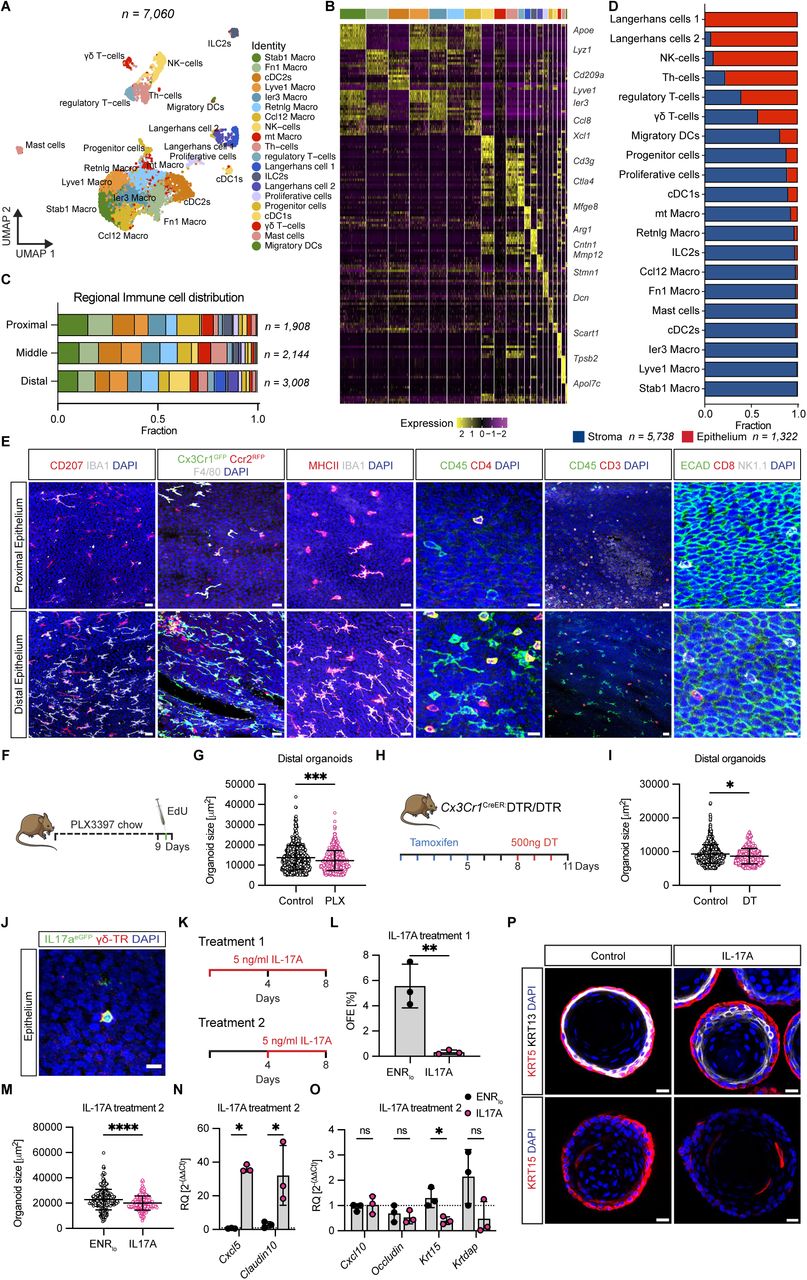
    (A) UMAP of cell identities of subclustered immune cells. (B) Heatmap of top 10 DEGs for all clusters displayed in (A). (C) Distribution of all immune cell populations within each sequenced proximal-distal region. Cell numbers are normalised within respective region, displaying fractions. (D) Quantification the distribution of all immune cell populations across compartment (stroma and epithelium). Fractions are normalised within cell each identity. (E) Immunofluorescent labelling of proximal and distal epithelial whole mounts using CD207 (Langerin), F4/80, Cx3cr1 CreER :GFP, Ccr2 CreER :RFP, IBA1, MHCII, CD45, CD4, CD3, CD8, and NK1.1, revealing distal enrichment of intra-epithelial immune cell populations. Scale bar = 20µm and 10µm for the CD45, CD4 staining panel. (F) Experimental setup for in vivo depletion of CSF1-dependent immune cells keeping mice on PLX3397 chow ad libitum for 9 days. EdU was injected i.p 1 hour before sacrifice. (G) Organoid size derived from the distal epithelium comparing control and PLX3397 chow immune cell depleted mice. n = 3 with 2 mice per n. Each dot represents one organoid. (H) Illustration of experimental setup for in vivo depletion of Cx3cr1 expressing immune cells using Cx3cr1 CreER :DTR mice. Tamoxifen was injected daily for 5 days (day 1-5) to induce expression of the diphtheria toxin receptor (DTR), after which diphtheria toxin (DT) was administered for 3 days (day 8-10). Mice were sacrificed on day 11. Control mice were treated with tamoxifen, but not DT. (I) Quantification of organoid sizes comparing distal organoids derived from control and DT injected mice. n = 3 with 2 mice per n. Each dot represents one organoid. (J) Immunofluorescent visualization of <t>IL-17A</t> eGFP (green) and ψ8-TR (red) on epithelial whole mounts. Scale bar = 10µm. (K) Schematic illustration of IL-17A treatment. IL-17A was either supplemented when plating cells (day 0, Treatment 1) or from day 4 of culture (Treatment 2). (L) Organoid forming efficiency (OFE) comparing control organoids to organoids grown in the presence of 5ng/mL IL-17A from day 0 onwards. n=3. (M) Quantification of organoid size comparing control to IL-17A when initiated at day 4 (Treatment 2). Each dot represents one organoid. (N) Relative gene expression of Cxcl5 and Claudin10 in organoids harvested at day 8, comparing IL-17A Treatment 2 and control. (O) Relative gene expression of Cxcl10 , Occludin , Krt15 and Krtdap in organoids harvested at day 8, comparing IL-17A Treatment 2 and control. (P) Immunofluorescent staining of organoid cross sections, comparing control to IL-17A treated organoids (Treatment 2). Organoids are stained for KRT5 (red, upper panel), KRT13 (white, upper panel), and KRT15 (red, lower panel) and counterstained with DAPI (blue). Scale bar = 20µm. (G, I, M) Two-tailed Kolmogorov-Smirnov test. ns p > 0.05, * p < 0.05, ** p < 0.01, *** p < 0.001. (L) Two-sided ratio paired t-test. ns p > 0.05, * p < 0.05, ** p < 0.01, *** p < 0.001. (N, O) Multiple ratio paired t-test corrected for multiple comparisons with Holm-Šídák method. ns p > 0.05, * p < 0.05, ** p < 0.01, *** p < 0.001.
    Il 17a, supplied by R&D Systems, used in various techniques. Bioz Stars score: 94/100, based on 1 PubMed citations. ZERO BIAS - scores, article reviews, protocol conditions and more
    https://www.bioz.com/result/il 17a/product/R&D Systems
    Average 94 stars, based on 1 article reviews
    il 17a - by Bioz Stars, 2026-02
    94/100 stars
      Buy from Supplier

    Image Search Results


    IL‐17A and IL‐17F gene and protein expression in lungs of BLM challenged mice. WT mice were treated with saline (CL, white bars) or BLM (grey bars) for 6 h, 24 h, 72 h, 7 days, 14 days, or 21 days, as indicated. (A, B) Gene expression levels of IL‐17A and IL‐17F in sorted TCRαβ pos (A) and TCRγδ pos T cells collected from lungs of BLM‐exposed WT mice. (C, D) Intracellular IL‐17A and IL‐17F protein expression of CD4 pos T cells (C) and TCRγδ pos T cells (D) of WT and IL17af −/− mice was measured 72 h post‐BLM by flow cytometry. (E, F) IL‐17A protein levels in BALF (E) and lung (F) of saline vs. BLM‐treated mice quantified by ELISA. Data are shown as scatter plots with mean values indicated as horizontal lines (A, B) or as mean ± SD of n = 9–12 (A, B), or n = 5–11 (C, D), or n = 4–8 (E, F) mice per group and time point. Note that in A and B, one data point represents a pool of T cells sorted from n = 2–3 mice per experimental group and time point. Data in (C–F) are representative of two independent experiments. * p ≤ 0.05, ** p ≤ 0.01 compared with mice from the control group (Mann–Whitney U ‐test).

    Journal: European Journal of Immunology

    Article Title: Innate T‐cell‐derived IL‐17A/F protects from bleomycin‐induced acute lung injury but not bleomycin or adenoviral TGF‐β1‐induced lung fibrosis in mice

    doi: 10.1002/eji.202451323

    Figure Lengend Snippet: IL‐17A and IL‐17F gene and protein expression in lungs of BLM challenged mice. WT mice were treated with saline (CL, white bars) or BLM (grey bars) for 6 h, 24 h, 72 h, 7 days, 14 days, or 21 days, as indicated. (A, B) Gene expression levels of IL‐17A and IL‐17F in sorted TCRαβ pos (A) and TCRγδ pos T cells collected from lungs of BLM‐exposed WT mice. (C, D) Intracellular IL‐17A and IL‐17F protein expression of CD4 pos T cells (C) and TCRγδ pos T cells (D) of WT and IL17af −/− mice was measured 72 h post‐BLM by flow cytometry. (E, F) IL‐17A protein levels in BALF (E) and lung (F) of saline vs. BLM‐treated mice quantified by ELISA. Data are shown as scatter plots with mean values indicated as horizontal lines (A, B) or as mean ± SD of n = 9–12 (A, B), or n = 5–11 (C, D), or n = 4–8 (E, F) mice per group and time point. Note that in A and B, one data point represents a pool of T cells sorted from n = 2–3 mice per experimental group and time point. Data in (C–F) are representative of two independent experiments. * p ≤ 0.05, ** p ≤ 0.01 compared with mice from the control group (Mann–Whitney U ‐test).

    Article Snippet: Recombinant mouse IL‐17A/F protein (rIL‐17A/F) was purchased from R&D Systems.

    Techniques: Expressing, Saline, Flow Cytometry, Enzyme-linked Immunosorbent Assay, Control, MANN-WHITNEY

    Therapy of BLM‐treated IL17af −/− mice with recombinant IL‐17A/F protein. (A) Experimental design. BLM‐exposed IL17af −/− mice were treated i.v. with rIL‐17A/F protein or vehicle, as indicated. (B) Histopathology of hematoxylin/eosin‐stained lung tissue section of IL17af −/− mice with or without rIL‐17A/F protein therapy at day 6 post‐BLM treatment. Closed arrows in (B, left histology) indicate angiocentric neutrophilic infiltrations, while open arrows in (B, left histology) denote intravascular coagulation in IL17af −/− mice treated with BLM for 6 days. Closed arrows in (B, right histology) indicate lymphoplasmacellular infiltrates in BLM‐treated IL17af −/− mice with rIL‐17A/F protein therapy. Representative histology images from a total of n = 4 mice per experimental group are shown at original magnifications of ×40 (Scale bar 20 µm). (C–E) Immunophenotypic analysis of neutrophils (C), CD4 pos T cells (D), and CD8 pos T cells (E) in BALF of BLM‐treated IL17af −/− mice in the absence or presence of rIL‐17A/F protein therapy. Data are shown as mean±SD of n = 5–6 mice per group and time point and are representative of two independent experiments. * p ≤ 0.05, ** p ≤ 0.01 compared with mice from the control group (CL). ++ p ≤ 0.01 rIL‐17A/F application relative to vehicle (Mann–Whitney U ‐test).

    Journal: European Journal of Immunology

    Article Title: Innate T‐cell‐derived IL‐17A/F protects from bleomycin‐induced acute lung injury but not bleomycin or adenoviral TGF‐β1‐induced lung fibrosis in mice

    doi: 10.1002/eji.202451323

    Figure Lengend Snippet: Therapy of BLM‐treated IL17af −/− mice with recombinant IL‐17A/F protein. (A) Experimental design. BLM‐exposed IL17af −/− mice were treated i.v. with rIL‐17A/F protein or vehicle, as indicated. (B) Histopathology of hematoxylin/eosin‐stained lung tissue section of IL17af −/− mice with or without rIL‐17A/F protein therapy at day 6 post‐BLM treatment. Closed arrows in (B, left histology) indicate angiocentric neutrophilic infiltrations, while open arrows in (B, left histology) denote intravascular coagulation in IL17af −/− mice treated with BLM for 6 days. Closed arrows in (B, right histology) indicate lymphoplasmacellular infiltrates in BLM‐treated IL17af −/− mice with rIL‐17A/F protein therapy. Representative histology images from a total of n = 4 mice per experimental group are shown at original magnifications of ×40 (Scale bar 20 µm). (C–E) Immunophenotypic analysis of neutrophils (C), CD4 pos T cells (D), and CD8 pos T cells (E) in BALF of BLM‐treated IL17af −/− mice in the absence or presence of rIL‐17A/F protein therapy. Data are shown as mean±SD of n = 5–6 mice per group and time point and are representative of two independent experiments. * p ≤ 0.05, ** p ≤ 0.01 compared with mice from the control group (CL). ++ p ≤ 0.01 rIL‐17A/F application relative to vehicle (Mann–Whitney U ‐test).

    Article Snippet: Recombinant mouse IL‐17A/F protein (rIL‐17A/F) was purchased from R&D Systems.

    Techniques: Recombinant, Histopathology, Staining, Coagulation, Control, MANN-WHITNEY

    AdTGF‐β1 induced lung fibrosis in WT and IL17af −/− mice. WT and IL17af −/− mice were left untreated (grey bars) or were treated with either AdCL (white bars) or AdTGF‐β1 (black bars) for up to 21 days. (A, B) IL‐17A protein levels in BALF (A) and lung (B) of AdCL vs. AdTGF‐β1‐treated mice. (C) Hydroxyproline levels in lung tissue of AdCL‐ vs. AdTGF‐β1‐treated WT and IL17af −/− mice. (D) Histopathology of hematoxylin/eosin‐stained lung tissue sections of WT and IL17af −/− mice at day 14 post‐AdCL vs. AdTGF‐β1 application. Data are shown as mean ± SD of at least n = 5–8 mice per experimental group and time point and are representative of two independent experiments. * p ≤ 0.05, ** p ≤ 0.01 compared with AdCL.

    Journal: European Journal of Immunology

    Article Title: Innate T‐cell‐derived IL‐17A/F protects from bleomycin‐induced acute lung injury but not bleomycin or adenoviral TGF‐β1‐induced lung fibrosis in mice

    doi: 10.1002/eji.202451323

    Figure Lengend Snippet: AdTGF‐β1 induced lung fibrosis in WT and IL17af −/− mice. WT and IL17af −/− mice were left untreated (grey bars) or were treated with either AdCL (white bars) or AdTGF‐β1 (black bars) for up to 21 days. (A, B) IL‐17A protein levels in BALF (A) and lung (B) of AdCL vs. AdTGF‐β1‐treated mice. (C) Hydroxyproline levels in lung tissue of AdCL‐ vs. AdTGF‐β1‐treated WT and IL17af −/− mice. (D) Histopathology of hematoxylin/eosin‐stained lung tissue sections of WT and IL17af −/− mice at day 14 post‐AdCL vs. AdTGF‐β1 application. Data are shown as mean ± SD of at least n = 5–8 mice per experimental group and time point and are representative of two independent experiments. * p ≤ 0.05, ** p ≤ 0.01 compared with AdCL.

    Article Snippet: Recombinant mouse IL‐17A/F protein (rIL‐17A/F) was purchased from R&D Systems.

    Techniques: Histopathology, Staining

    A,B. Colonoids were prepared from control mice ( Duoxa1/a2 fl/fl ) or those lacking functional intestinal DUOX2 ( Duoxa1/a2 ΔIEC mice) to evaluate H 2 O 2 production and gene expression in response to recombinant murine IL-17 (rmIL-17). Colonoids were stimulated for 24 h with 5 ng/mL of rmIL-17A or the equivalent amount of carrier BSA protein (n=6 cultures). Lipopolysaccharide (LPS) was used as a positive control. A. H 2 O 2 production rates were normalized to MTT viability values. Data were analyzed by two-way ANOVA followed by Tukey’s post-hoc test. B. Transcript expression levels for Duox2 and Duoxa2 were determined in colonoids stimulated for 24 h with BSA, rmIL-17A, or LPS (n=6 cultures). Data were analyzed by means of Kruskal-Wallis test for each individual gene. *- p≤0.05, **- p≤0.01, ns- not significant. C . WT C57BL/6J and Il17ra -/- mice were treated with fluconazole (Flz) and the antibiotics penicillin, streptomycin, and vancomycin (Ab) followed by colonization with C. albicans SC5314 for 7 days (with Ab treatment continued throughout the experiment). D. Fungal colonization levels were determined from fecal pellets and GI organs at 7 dpi. Duo-Duodenum, Jej-Jejunum, Ile-Ileum, Col-Colon. E. The proportion of yeast and hyphal cells was determined from the ileum and colon of C. albicans- colonized WT (n=6 per group) and Il17ra -/- (n=5 per group) mice. Paraffin embedded tissue sections were deparaffinized and stained with an anti- Candida antibody, epithelial nuclei were stained with DAPI and mucus was stained with rhodamine-conjugated UEA-1 and WGA-1. 500-1000 cells were counted from each tissue section. Data is presented as standard error of mean (SEM). Statistical significance was determined using unpaired t-test and **- p≤0.01, ***- p≤0.001. F,G . Duox2 / Duoxa2 expression was determined by qRT-PCR in ileum ( F ) and colon ( G ) tissues of C. albicans WT SC5314-colonized mice (n=6 per group) and Il17ra -/- mice (n=5 per group). Data is presented as relative expression with SEM. Unpaired t-test was used to determine statistical significance; ns-not significant and *- p≤0.05, **- p≤0.01, ***- p≤0.001.

    Journal: bioRxiv

    Article Title: An IL-17-DUOX2 axis controls gastrointestinal colonization by Candida albicans

    doi: 10.1101/2024.08.16.608271

    Figure Lengend Snippet: A,B. Colonoids were prepared from control mice ( Duoxa1/a2 fl/fl ) or those lacking functional intestinal DUOX2 ( Duoxa1/a2 ΔIEC mice) to evaluate H 2 O 2 production and gene expression in response to recombinant murine IL-17 (rmIL-17). Colonoids were stimulated for 24 h with 5 ng/mL of rmIL-17A or the equivalent amount of carrier BSA protein (n=6 cultures). Lipopolysaccharide (LPS) was used as a positive control. A. H 2 O 2 production rates were normalized to MTT viability values. Data were analyzed by two-way ANOVA followed by Tukey’s post-hoc test. B. Transcript expression levels for Duox2 and Duoxa2 were determined in colonoids stimulated for 24 h with BSA, rmIL-17A, or LPS (n=6 cultures). Data were analyzed by means of Kruskal-Wallis test for each individual gene. *- p≤0.05, **- p≤0.01, ns- not significant. C . WT C57BL/6J and Il17ra -/- mice were treated with fluconazole (Flz) and the antibiotics penicillin, streptomycin, and vancomycin (Ab) followed by colonization with C. albicans SC5314 for 7 days (with Ab treatment continued throughout the experiment). D. Fungal colonization levels were determined from fecal pellets and GI organs at 7 dpi. Duo-Duodenum, Jej-Jejunum, Ile-Ileum, Col-Colon. E. The proportion of yeast and hyphal cells was determined from the ileum and colon of C. albicans- colonized WT (n=6 per group) and Il17ra -/- (n=5 per group) mice. Paraffin embedded tissue sections were deparaffinized and stained with an anti- Candida antibody, epithelial nuclei were stained with DAPI and mucus was stained with rhodamine-conjugated UEA-1 and WGA-1. 500-1000 cells were counted from each tissue section. Data is presented as standard error of mean (SEM). Statistical significance was determined using unpaired t-test and **- p≤0.01, ***- p≤0.001. F,G . Duox2 / Duoxa2 expression was determined by qRT-PCR in ileum ( F ) and colon ( G ) tissues of C. albicans WT SC5314-colonized mice (n=6 per group) and Il17ra -/- mice (n=5 per group). Data is presented as relative expression with SEM. Unpaired t-test was used to determine statistical significance; ns-not significant and *- p≤0.05, **- p≤0.01, ***- p≤0.001.

    Article Snippet: On day 4, colonoids were challenged with sonicates of C. albicans SC5314 in yeast and hyphal forms (10 7 cells/mL); β-1,3-curdlan from Alcaligenes faecalis (100 µg/mL in DMSO; Invivogen); mannan (250 µg/mL in 1:1 PBS/DMSO solution; Millipore-Sigma), zymosan A (250 µg/mL in 1:1 PBS/DMSO solution; Millipore-Sigma), β-glucan from Saccharomyces cerevisiae (100 µg/mL in 1:1 PBS/DMSO solution; Millipore-Sigma); recombinant mouse IL-17A (5 ng/mL; R&D Systems); or the appropriate vehicles and carrier proteins for 24 h. All ligands and cytokines were preincubated with polymyxin B (PMB; 25 µg/mL; Millipore-Sigma) for 30 min at 37°C to prevent activation by lipopolysaccharide (LPS) contamination.

    Techniques: Control, Functional Assay, Expressing, Recombinant, Positive Control, Staining, Quantitative RT-PCR

    (A) UMAP of cell identities of subclustered immune cells. (B) Heatmap of top 10 DEGs for all clusters displayed in (A). (C) Distribution of all immune cell populations within each sequenced proximal-distal region. Cell numbers are normalised within respective region, displaying fractions. (D) Quantification the distribution of all immune cell populations across compartment (stroma and epithelium). Fractions are normalised within cell each identity. (E) Immunofluorescent labelling of proximal and distal epithelial whole mounts using CD207 (Langerin), F4/80, Cx3cr1 CreER :GFP, Ccr2 CreER :RFP, IBA1, MHCII, CD45, CD4, CD3, CD8, and NK1.1, revealing distal enrichment of intra-epithelial immune cell populations. Scale bar = 20µm and 10µm for the CD45, CD4 staining panel. (F) Experimental setup for in vivo depletion of CSF1-dependent immune cells keeping mice on PLX3397 chow ad libitum for 9 days. EdU was injected i.p 1 hour before sacrifice. (G) Organoid size derived from the distal epithelium comparing control and PLX3397 chow immune cell depleted mice. n = 3 with 2 mice per n. Each dot represents one organoid. (H) Illustration of experimental setup for in vivo depletion of Cx3cr1 expressing immune cells using Cx3cr1 CreER :DTR mice. Tamoxifen was injected daily for 5 days (day 1-5) to induce expression of the diphtheria toxin receptor (DTR), after which diphtheria toxin (DT) was administered for 3 days (day 8-10). Mice were sacrificed on day 11. Control mice were treated with tamoxifen, but not DT. (I) Quantification of organoid sizes comparing distal organoids derived from control and DT injected mice. n = 3 with 2 mice per n. Each dot represents one organoid. (J) Immunofluorescent visualization of IL-17A eGFP (green) and ψ8-TR (red) on epithelial whole mounts. Scale bar = 10µm. (K) Schematic illustration of IL-17A treatment. IL-17A was either supplemented when plating cells (day 0, Treatment 1) or from day 4 of culture (Treatment 2). (L) Organoid forming efficiency (OFE) comparing control organoids to organoids grown in the presence of 5ng/mL IL-17A from day 0 onwards. n=3. (M) Quantification of organoid size comparing control to IL-17A when initiated at day 4 (Treatment 2). Each dot represents one organoid. (N) Relative gene expression of Cxcl5 and Claudin10 in organoids harvested at day 8, comparing IL-17A Treatment 2 and control. (O) Relative gene expression of Cxcl10 , Occludin , Krt15 and Krtdap in organoids harvested at day 8, comparing IL-17A Treatment 2 and control. (P) Immunofluorescent staining of organoid cross sections, comparing control to IL-17A treated organoids (Treatment 2). Organoids are stained for KRT5 (red, upper panel), KRT13 (white, upper panel), and KRT15 (red, lower panel) and counterstained with DAPI (blue). Scale bar = 20µm. (G, I, M) Two-tailed Kolmogorov-Smirnov test. ns p > 0.05, * p < 0.05, ** p < 0.01, *** p < 0.001. (L) Two-sided ratio paired t-test. ns p > 0.05, * p < 0.05, ** p < 0.01, *** p < 0.001. (N, O) Multiple ratio paired t-test corrected for multiple comparisons with Holm-Šídák method. ns p > 0.05, * p < 0.05, ** p < 0.01, *** p < 0.001.

    Journal: bioRxiv

    Article Title: Regionalized cell and gene signatures govern oesophageal epithelial homeostasis

    doi: 10.1101/2024.02.21.581361

    Figure Lengend Snippet: (A) UMAP of cell identities of subclustered immune cells. (B) Heatmap of top 10 DEGs for all clusters displayed in (A). (C) Distribution of all immune cell populations within each sequenced proximal-distal region. Cell numbers are normalised within respective region, displaying fractions. (D) Quantification the distribution of all immune cell populations across compartment (stroma and epithelium). Fractions are normalised within cell each identity. (E) Immunofluorescent labelling of proximal and distal epithelial whole mounts using CD207 (Langerin), F4/80, Cx3cr1 CreER :GFP, Ccr2 CreER :RFP, IBA1, MHCII, CD45, CD4, CD3, CD8, and NK1.1, revealing distal enrichment of intra-epithelial immune cell populations. Scale bar = 20µm and 10µm for the CD45, CD4 staining panel. (F) Experimental setup for in vivo depletion of CSF1-dependent immune cells keeping mice on PLX3397 chow ad libitum for 9 days. EdU was injected i.p 1 hour before sacrifice. (G) Organoid size derived from the distal epithelium comparing control and PLX3397 chow immune cell depleted mice. n = 3 with 2 mice per n. Each dot represents one organoid. (H) Illustration of experimental setup for in vivo depletion of Cx3cr1 expressing immune cells using Cx3cr1 CreER :DTR mice. Tamoxifen was injected daily for 5 days (day 1-5) to induce expression of the diphtheria toxin receptor (DTR), after which diphtheria toxin (DT) was administered for 3 days (day 8-10). Mice were sacrificed on day 11. Control mice were treated with tamoxifen, but not DT. (I) Quantification of organoid sizes comparing distal organoids derived from control and DT injected mice. n = 3 with 2 mice per n. Each dot represents one organoid. (J) Immunofluorescent visualization of IL-17A eGFP (green) and ψ8-TR (red) on epithelial whole mounts. Scale bar = 10µm. (K) Schematic illustration of IL-17A treatment. IL-17A was either supplemented when plating cells (day 0, Treatment 1) or from day 4 of culture (Treatment 2). (L) Organoid forming efficiency (OFE) comparing control organoids to organoids grown in the presence of 5ng/mL IL-17A from day 0 onwards. n=3. (M) Quantification of organoid size comparing control to IL-17A when initiated at day 4 (Treatment 2). Each dot represents one organoid. (N) Relative gene expression of Cxcl5 and Claudin10 in organoids harvested at day 8, comparing IL-17A Treatment 2 and control. (O) Relative gene expression of Cxcl10 , Occludin , Krt15 and Krtdap in organoids harvested at day 8, comparing IL-17A Treatment 2 and control. (P) Immunofluorescent staining of organoid cross sections, comparing control to IL-17A treated organoids (Treatment 2). Organoids are stained for KRT5 (red, upper panel), KRT13 (white, upper panel), and KRT15 (red, lower panel) and counterstained with DAPI (blue). Scale bar = 20µm. (G, I, M) Two-tailed Kolmogorov-Smirnov test. ns p > 0.05, * p < 0.05, ** p < 0.01, *** p < 0.001. (L) Two-sided ratio paired t-test. ns p > 0.05, * p < 0.05, ** p < 0.01, *** p < 0.001. (N, O) Multiple ratio paired t-test corrected for multiple comparisons with Holm-Šídák method. ns p > 0.05, * p < 0.05, ** p < 0.01, *** p < 0.001.

    Article Snippet: All supplemented media are based on ENR lo medium and contain either, 250ng/ml recombinant IGF1 (Peprotech, #100-11), 250ng/ml recombinant WNT5A (R&D systems, #645-WN-010), 100ng/ml BMP4 (R&D systems, #5020-BP-010), 5ng/ml IL-17A (R&D systems, #421-ML-025/CF), or 100ng/ml recombinant NRG1 (Biotechne, #9875-NR-050).

    Techniques: Staining, In Vivo, Injection, Derivative Assay, Control, Expressing, Two Tailed Test

    (A) DotPlot of the top differentially expressed gene (log2 fold-change) of subclustered immune cell types. (B) UMAP of subclustered immune cells colour-coded by oesophageal region. (C) UMAP of subclustered immune cells colour-coded by oesophageal compartment. (D) Distribution of subclustered immune cells across oesophageal regions normalised within cell identity. (E) UMAP dimensional reduction plot and gating strategy for flow cytometry determined immune cell identities. (F) Heatmaps displaying the relative regional (green) and compartmental (pick) distribution of spectral flow cytometry analysed immune cell identities. (G) Csf1r and Cx3cr1 expression in immune cells. (H) Representative immunofluorescent images of epithelial whole mounts of control and PLX3397 chow mice counterstained for EdU (green), CD45 (white), MHCII (red), and DAPI (blue). Scale bar = 20µm. (I) Organoid size of proximally derived organoids from control and PLX3397 chow mice. n = 3 (2 mice per n). Each dot represents one organoid. (J) Representative immunofluorescent images of oesophageal epithelial whole mounts of control mice and Cx3cr1-CreER:DTR/DTR immune cell depleted mice counterstained for KI67 (white), CD45 (green), DTR (red), and DAPI (blue). Scale bar = 50 µm and inlets 20 µm. (K) Quantification of DTR-positive, recombined, CD45- positive cells in the proximal, middle and distal oesophagus comparing control (no DT) to DT injected mice. (L) Comparing size of organoids derived from proximal basal cells in control and DT treated mice. n = 3 with 2 mice per n. Each dot represents one organoid. (M) Cellchat- inferred probable communication, indicating that IL-17A, produced by intra-epithelial ψ8T- cells, impacts proliferating as well as differentiating epithelial cell populations. (I, L) Two- tailed Kolmogorov-Smirnov test. ns p > 0.05, * p < 0.05, ** p < 0.01, *** p < 0.001. (K) Multiple unpaired t-test corrected for multiple comparisons with Holm-Šídák method. ns p > 0.05, * p < 0.05, ** p < 0.01, *** p < 0.001.

    Journal: bioRxiv

    Article Title: Regionalized cell and gene signatures govern oesophageal epithelial homeostasis

    doi: 10.1101/2024.02.21.581361

    Figure Lengend Snippet: (A) DotPlot of the top differentially expressed gene (log2 fold-change) of subclustered immune cell types. (B) UMAP of subclustered immune cells colour-coded by oesophageal region. (C) UMAP of subclustered immune cells colour-coded by oesophageal compartment. (D) Distribution of subclustered immune cells across oesophageal regions normalised within cell identity. (E) UMAP dimensional reduction plot and gating strategy for flow cytometry determined immune cell identities. (F) Heatmaps displaying the relative regional (green) and compartmental (pick) distribution of spectral flow cytometry analysed immune cell identities. (G) Csf1r and Cx3cr1 expression in immune cells. (H) Representative immunofluorescent images of epithelial whole mounts of control and PLX3397 chow mice counterstained for EdU (green), CD45 (white), MHCII (red), and DAPI (blue). Scale bar = 20µm. (I) Organoid size of proximally derived organoids from control and PLX3397 chow mice. n = 3 (2 mice per n). Each dot represents one organoid. (J) Representative immunofluorescent images of oesophageal epithelial whole mounts of control mice and Cx3cr1-CreER:DTR/DTR immune cell depleted mice counterstained for KI67 (white), CD45 (green), DTR (red), and DAPI (blue). Scale bar = 50 µm and inlets 20 µm. (K) Quantification of DTR-positive, recombined, CD45- positive cells in the proximal, middle and distal oesophagus comparing control (no DT) to DT injected mice. (L) Comparing size of organoids derived from proximal basal cells in control and DT treated mice. n = 3 with 2 mice per n. Each dot represents one organoid. (M) Cellchat- inferred probable communication, indicating that IL-17A, produced by intra-epithelial ψ8T- cells, impacts proliferating as well as differentiating epithelial cell populations. (I, L) Two- tailed Kolmogorov-Smirnov test. ns p > 0.05, * p < 0.05, ** p < 0.01, *** p < 0.001. (K) Multiple unpaired t-test corrected for multiple comparisons with Holm-Šídák method. ns p > 0.05, * p < 0.05, ** p < 0.01, *** p < 0.001.

    Article Snippet: All supplemented media are based on ENR lo medium and contain either, 250ng/ml recombinant IGF1 (Peprotech, #100-11), 250ng/ml recombinant WNT5A (R&D systems, #645-WN-010), 100ng/ml BMP4 (R&D systems, #5020-BP-010), 5ng/ml IL-17A (R&D systems, #421-ML-025/CF), or 100ng/ml recombinant NRG1 (Biotechne, #9875-NR-050).

    Techniques: Flow Cytometry, Expressing, Control, Derivative Assay, Injection, Produced, Two Tailed Test